
Vea también


 13.07.2026 12:55 AM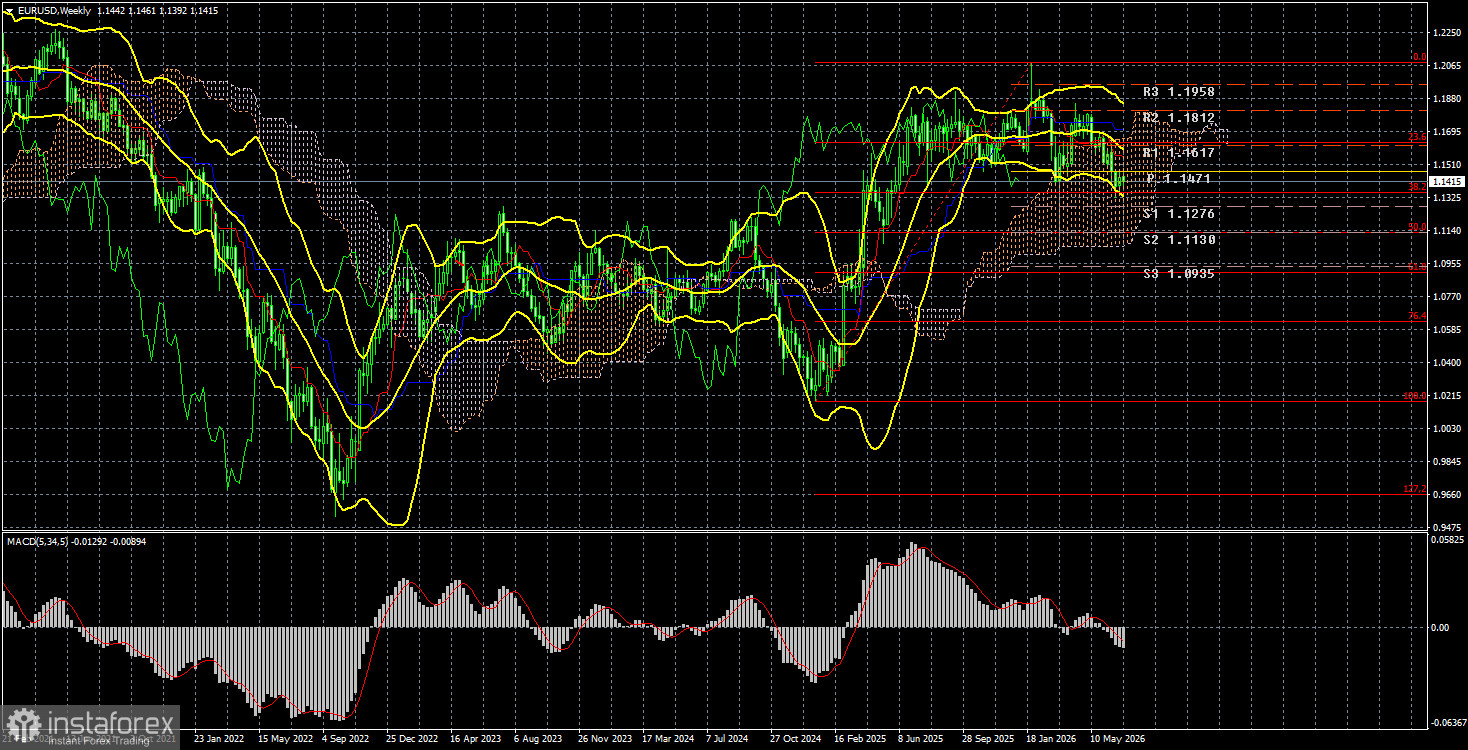
The EUR/USD currency pair had a boring week, with average volatility of 40 pips. It is evident that such volatility indicates only one thing – there are virtually no movements in the market. To be fair, there were virtually no important events this week. Among macroeconomic reports, we can note only the ISM Business Activity Index, whose value fully matched the forecasts. Among fundamental events, we can only mention the Federal Reserve's minutes, which are always exceptionally formal documents. Among geopolitical events, we can highlight another escalation and ceasefire violation in the Middle East, among dozens we have already seen in recent months.
As a result, the market completely ignored both macroeconomics, fundamentals, and geopolitics, as there was virtually nothing to react to. We would like to say a few words about geopolitics separately. Essentially, the situation between the U.S. and Iran remains unchanged. The negotiations are formally ongoing, but Iran refuses any meetings with the American delegation. Tehran is only willing to negotiate through intermediaries. In our view, this fact best illustrates Tehran's desire to negotiate with the U.S. Since there is not much desire, "but they need to negotiate," the talks are progressing very slowly, and there is still no progress on key issues. Each side of the conflict fears demonstrating weakness the most, which is why Donald Trump claims every day that he would have long since crushed Iran, but world leaders and Iran itself constantly persuade him not to do so. However, Tehran continues to refute most of Trump's statements.
Constant escalations near the Strait of Hormuz also indicate that no one wants to give in. Iran wishes to have full control over the strait and to define the rules of the game therein. Trump fully understands that imposing a toll for passing through Hormuz (which Iran wants to implement) is a complete defeat. Before the war, the Strait of Hormuz was open and free, so Trump cannot allow Iran to collect tributes from all ships. We are not even discussing the "nuclear issue" now, as there is no chance the parties will start discussing it in the near future. We still believe that the negotiations between the U.S. and Iran are merely formal and will not yield anything fruitful. Perhaps, after many years, Tehran and Washington will manage to agree on a long-term peace, but certainly not in the near future.
Meanwhile, the European currency has dropped to the 14th level. In this article, we specifically provide the weekly timeframe to understand the long-term perspective. Currently, the upward trend that began in 2022 continues, and the cumulative correction of the dollar is 38.2% according to Fibonacci. Spoiler alert: the British pound has also corrected by the same 38.2%. There are still no global growth factors for the American currency, and in 2026, the dollar has already exhausted all its trump cards. Therefore, we still expect the resumption of a global upward trend. Despite fairly strong dollar growth on lower timeframes, on higher timeframes it represents a weak correction.
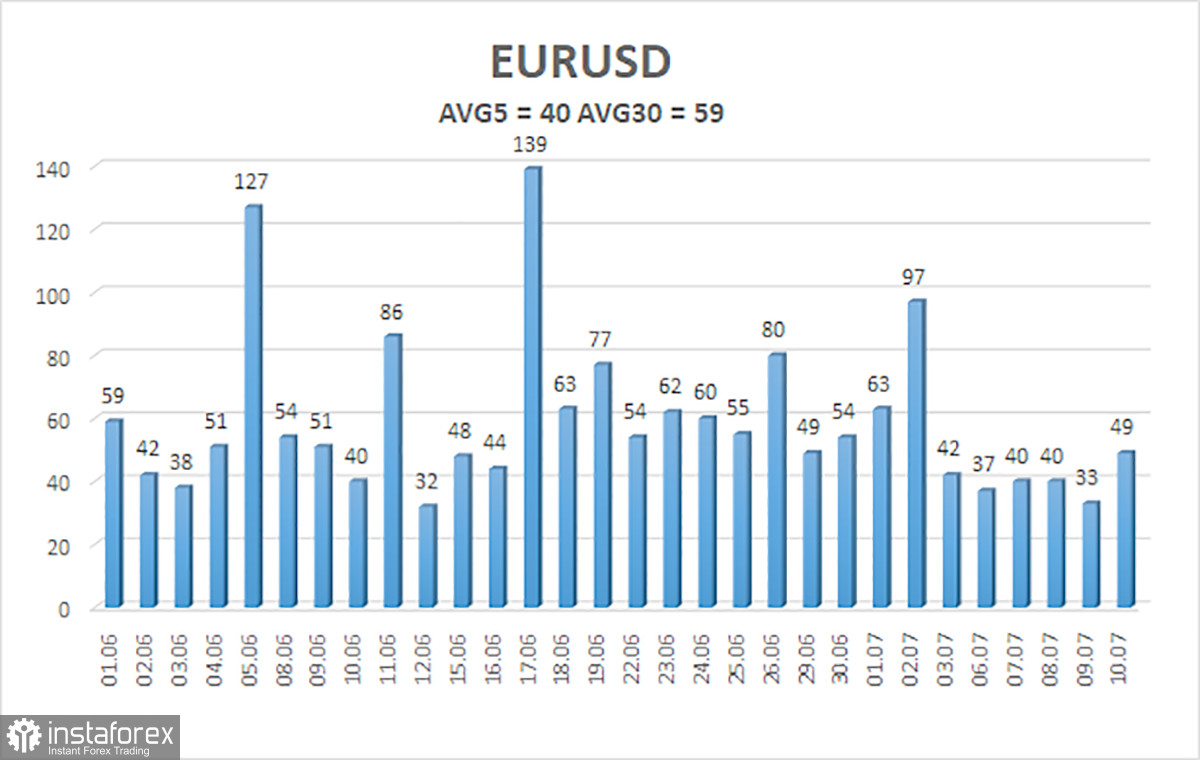
The average volatility of the EUR/USD currency pair over the last 5 trading days as of July 12 is 40 pips and is characterized as "low." We expect the pair to move between 1.1374 and 1.1454 on Monday. The upper channel of the linear regression is directed downward, indicating a continuation of the downward trend. The CCI indicator has entered the oversold territory and formed two bullish divergences, warning of a possible end to the downward trend.
S1 – 1.1414
S2 – 1.1353
S3 – 1.1292
R1 – 1.1475
R2 – 1.1536
R3 – 1.1597
The EUR/USD pair maintains a downward trend, presumably a correction within a broader upward trend, as is clearly evident on the daily or weekly timeframe. The global fundamental backdrop for the dollar remains negative, but in 2026, first geopolitics and then the Fed's hawkish stance have provided powerful support for the American currency. When the price is below the moving average, short positions targeting 1.1374 and 1.1353 can be considered. Above the moving average line, long positions with targets of 1.1454 and 1.1475 are relevant. Bears are currently extremely strong for no apparent reason.
Linear regression channels help determine the current trend. If both are directed in the same way, then the trend is currently strong;
The moving average line (settings 20,0, smoothed) determines the short-term trend and the direction in which trading should be conducted;
Murray's levels are target levels for movements and corrections;
Volatility levels (red lines) indicate the likely price channel in which the pair will move in the coming days, based on current volatility indicators;
The CCI indicator—its entry into oversold territory (below -250) or overbought territory (above +250) indicates that a trend reversal in the opposite direction is approaching.


