
See also


 24.09.2026 08:54 AM
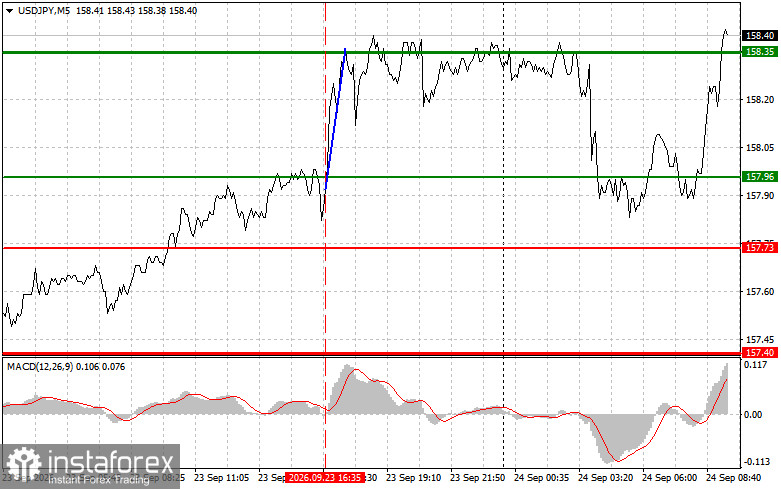
The price test at 157.96 occurred as the MACD indicator began moving up from the zero line, confirming a correct entry point to buy the dollar. As a result, the pair rose toward the 158.35 target.
As yesterday's data showed, the US composite PMI unexpectedly jumped in September to 58.4 from 56.0 in August, which led to a new wave of yen weakness and US dollar strength. Today's figures for Japan's business activity growth in September pointed to a slowdown to a four-month low. The composite PMI fell to 52.5 from 53.5 in August, and only the services sector showed modest expansion. In the moment, the yen strengthened, although, in essence, without direct currency interventions, there are still few willing to buy it aggressively even after the Bank of Japan's recent rate increase and its confirmed course toward further tightening. Meanwhile, the US economy is showing its best growth rate in five years, while Japan, judging by the latest figures, is losing momentum. The divergence in the two economies' trajectories, in my view, continues to work against the yen more than the interest-rate differential alone, and without comparably strong signals from Tokyo, USD/JPY will likely retain room for further upside.
For intraday strategy, I will rely mainly on Scenarios No. 1 and No. 2.
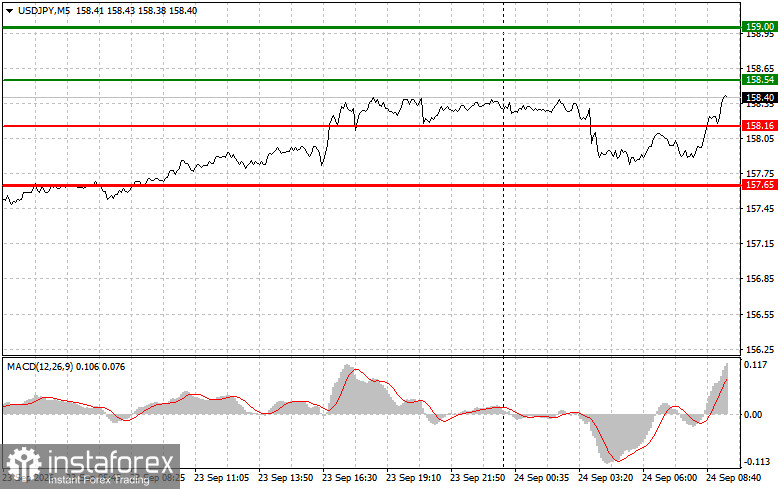
Scenario No 1: I plan to buy USD/JPY today if price reaches the entry area around 158.54 (green line on the chart) with a target of 159.00 (thicker green line on the chart). Around 159.00, I plan to exit long positions and open short positions in the opposite direction (expecting a 30–35 pip counter-move). It is best to return to buying the pair on corrections and significant pullbacks in USD/JPY. Important: before buying, ensure the MACD indicator is above zero and has just begun rising from it.
Scenario No 2: I also plan to buy USD/JPY if the price tests 158.16 twice in a row while MACD is in the oversold area. This would limit the pair's downside potential and lead to an upward reversal. Expect moves up to 158.54 and 159.00.
Scenario No 1: I plan to sell USD/JPY today only after the 158.16 level is broken (red line on the chart), which should lead to a rapid decline in the pair. The sellers' key target will be 157.65, where I plan to exit shorts and immediately open longs in the opposite direction (expecting a 20–25 pip counter-move). Sellers can return at any moment—it only takes a hint from the central bank. Important: before selling, ensure the MACD indicator is below zero and has just begun to fall from it.
Scenario No 2: I also plan to sell USD/JPY if the price tests 158.54 twice in a row while MACD is in the overbought area. This would limit upside potential and trigger a downward reversal. Expect falls toward 158.16 and 157.65.
Important: Beginner traders in the Forex market need to be very cautious when making entry decisions. It is best to stay out of the market ahead of significant fundamental reports to avoid being caught in sharp price fluctuations. If you decide to trade during news releases, always set stop orders to minimize losses. Without stop orders, you can quickly lose your entire deposit, especially if you do not employ money management practices and trade large volumes.
Also, remember that successful trading requires a clear trading plan, similar to the one provided above. Making spontaneous trading decisions based on current market conditions is inherently a losing strategy for intraday traders.


