
See also


 04.08.2026 01:02 PM
Bitcoin continues to hold yesterday's gains, trading at around $63,700, and shows no signs of slowing down today. Ethereum remains above $1,850 but below the key psychological level of $1,900.

Earlier today, it was reported that Strategy sold 1,638 bitcoins last week. This marked the company's third such transaction this year, but the context of the sale proved far more significant than the figures themselves. Strategy had not purchased any bitcoin for more than five weeks, a sharp contrast to its previous practice of acquiring the asset whenever possible. For the first time in its history, the world's largest corporate bitcoin treasury has sold part of its holdings not to reinvest the proceeds, but to meet current financial obligations. This comes at the very moment when Michael Saylor publicly denied that the company had ever maintained a policy of never selling bitcoin.
According to the company's filing with the U.S. Securities and Exchange Commission (SEC), the sale took place between July 27 and August 2 at an average price of $63,957 per bitcoin, significantly below the company's average purchase price of $75,419. As a result, the transaction was executed at a loss relative to the asset's carrying value. The $104.7 million in proceeds was divided almost equally: $52.4 million was allocated to dividend payments on preferred shares, while $52.3 million was used to repurchase the company's STRC shares. At the same time, Strategy raised $290.6 million through the sale of 3.01 million MSTR shares, with $250 million added to its U.S. dollar reserves, increasing them to $4 billion, and $81.2 million allocated to additional STRC share buybacks. Following the transaction, Strategy's bitcoin holdings declined to 842,138 BTC, representing approximately 4% of bitcoin's maximum supply of 21 million coins, with a market value of about $53 billion at current prices.
These developments logically reinforce the conclusion first outlined in the company's second-quarter report, when it posted a loss of $8.22 billion, and in the subsequent public debate involving Michael Saylor over whether Strategy had ever maintained a formal policy of indefinite bitcoin accumulation. On August 2, the company's founder stated that he now monitors the ratio of bitcoin's price to its 200-week moving average, as well as the asset's premium relative to that level. This shift in rhetoric—from uncompromising accumulation to active capital structure management involving regular partial sales—demonstrates that even the strongest symbol of the corporate bitcoin accumulation strategy has been forced to adapt to the prolonged pressure on the asset's price.
As for short-term trading, the strategy and trading scenarios are outlined below.
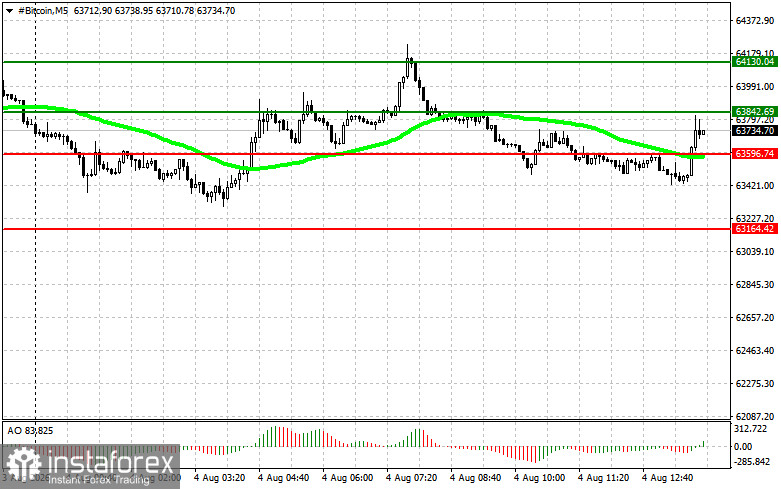
Scenario #1: Consider buying Bitcoin after a move to $63,800, targeting a rise to $64,100. At $64,100, consider closing long positions and opening short positions on a rebound. Before buying on a breakout, make sure that the 50-day Moving Average is below the current price and that the Awesome Oscillator remains above the zero line.
Scenario #2: Bitcoin may also be bought from the $63,500 support level if there is no strong market reaction following a false breakout, targeting $63,800 and $64,100.
Scenario #1: Consider selling Bitcoin after a move to $63,500, targeting a decline to $63,100. At $63,100, consider closing short positions and opening long positions on a rebound. Before selling on a breakout, make sure that the 50-day Moving Average is above the current price and that the Awesome Oscillator remains below the zero line.
Scenario #2: Bitcoin may also be sold from the $63,800 resistance level if there is no strong market reaction following a false breakout, targeting $63,500 and $63,100.
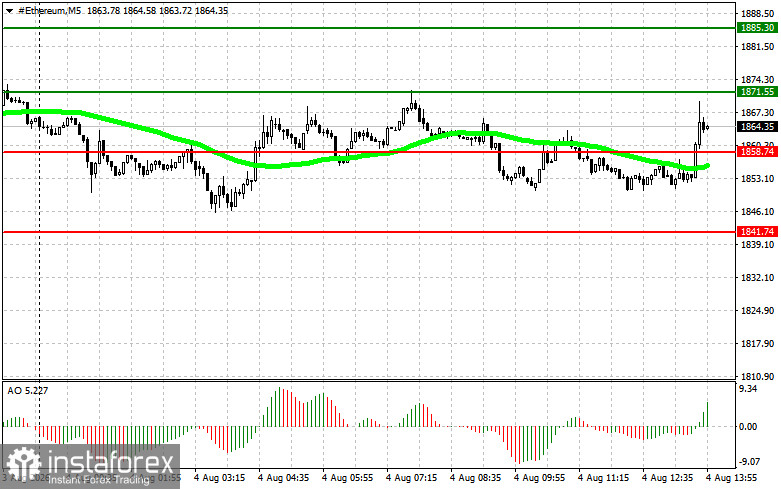
Scenario #1: Consider buying Ethereum after a move to $1,871, targeting a rise to $1,885. At $1,885, consider closing long positions and opening short positions on a rebound. Before buying on a breakout, make sure that the 50-day Moving Average is below the current price and that the Awesome Oscillator remains above the zero line.
Scenario #2: Ethereum may also be bought from the $1,858 support level if there is no strong market reaction following a false breakout, targeting $1,871 and $1,885.
Scenario #1: Consider selling Ethereum after a move to $1,858, targeting a decline to $1,841. At $1,841, consider closing short positions and opening long positions on a rebound. Before selling on a breakout, make sure that the 50-day Moving Average is above the current price and that the Awesome Oscillator remains below the zero line.
Scenario #2: Ethereum may also be sold from the $1,871 resistance level if there is no strong market reaction following a false breakout, targeting $1,858 and $1,841.


