
Vea también


 12.08.2026 12:39 AM
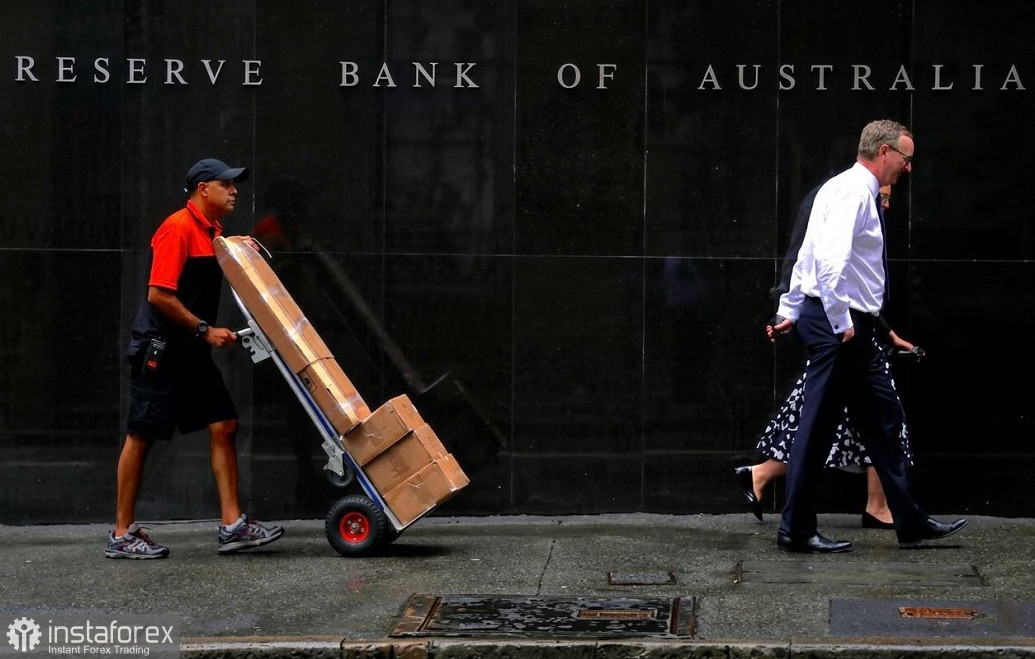
The Reserve Bank of Australia, following Tuesday's — August — meeting, unsurprisingly kept the cash rate unchanged at 4.35%. The decision was predictable and unanimous, but the accompanying rhetoric and the updated forecasts reflected a softening of the central bank's stance. The RBA acknowledged that monetary policy remains "somewhat restrictive," and labor market conditions have "weakened more than expected" in recent months. At the same time, the updated central bank forecasts imply a higher unemployment rate and lower underlying inflation.
For this reason, the Australian dollar's initial reaction to the RBA decision was negative. The AUD/USD pair, in particular, refreshed a local low (0.7040), reflecting the general weakening of the Aussie across the market.
The August RBA decision itself brought nothing new to the market: the parameters of monetary policy remained unchanged, fully meeting investors' expectations. However, the rhetoric in the accompanying statement disappointed the hawks, as the central bank made it clear that the previous tightening is already having the intended effect on the economy and that the space for further rate increases has narrowed noticeably.
The most important change in the final communique was the adjustment of the wording regarding the conditions for tightening monetary policy. Previously, the Board of Governors stated a readiness to raise the rate "if required," whereas now the rate would be raised if upside risks to inflation materialize. At first glance, the difference in wording may seem minor, but for markets it is fundamentally important. The previous formulation suggested that a rate hike remained one of the readily available policy tools. The updated phrasing effectively puts that scenario into a conditional category — additional evidence of rising inflationary pressure must first appear. And this comes against the backdrop of slowing overall inflation in the first quarter (headline CPI fell to 0.6% q/q, after a 1.0% rise in the first quarter).
A notable signal (not in the Aussie's favor) was the updated forecasts. The RBA raised its unemployment forecast while lowering its trimmed-mean inflation projections, which are crucial for the central bank when assessing the durability of price pressures.
In other words, the central bank now allows for a more pronounced cooling of the labor market while expecting a more favorable trajectory for underlying inflation. This forecast scenario reduces the need for further monetary tightening, at least in the context of the next meeting.
However, the press conference by RBA Governor Michele Bullock effectively reversed the initially soft perception of the meeting's results: the emphasis shifted from progress on inflation to persistent inflationary risks. Bullock made it clear that the option of further rate increases remains "on the table," since the Australian economy continues to operate above its potential. Moreover, the governor stressed that for a sustainable reduction in inflationary pressure, aggregate demand must remain sufficiently weak to relieve pressure on productive capacity.
Bullock's stance was a cold shower for AUD/USD sellers who had clearly expected softer signals from the head of the central bank. It became apparent that cuts in inflation forecasts alone do not mean the RBA has closed the tightening cycle.
It is also worth noting that the governor did not place much weight on the weakening of the Australian labor market and did not treat the deterioration as an argument for easing rhetoric. Moreover, Bullock's comments suggest that the RBA does not yet view the cooling of the labor market as sufficient reason to ease policy. In her view, the economy continues to run with excess demand, so even with a deterioration in the labor market there remain risks of a renewed rise in inflationary pressure.
In short, the RBA has indeed become more cautious in its textual formulations, but it has not become "dovish" in the classic sense. De facto inflation remains too high for the central bank, so, in the event of renewed upward price pressure, the RBA preserves the ability to raise the rate again.
Thus, the formal outcomes of the August RBA meeting were softer than the market expected. Still, the central bank governor's rhetoric did not allow traders to completely rule out a rate increase in the foreseeable future. Therefore, Tuesday's recovery in AUD/USD looks natural and justified.
On the four?hour chart, the pair is positioned between the middle and upper lines of the Bollinger Bands and above all Ichimoku lines, which has formed a bullish "Parade of Lines" signal. On the daily chart, the pair is also between the middle and upper Bollinger Bands, above Tenkan?sen and Kijun?sen, but within the Kumo cloud. The nearest target for upward movement is 0.7090 (upper Bollinger Band on H4). Clearing this target will open the path for AUD/USD toward the 0.71 figure.


