
Veja também


 12.06.2026 06:29 PM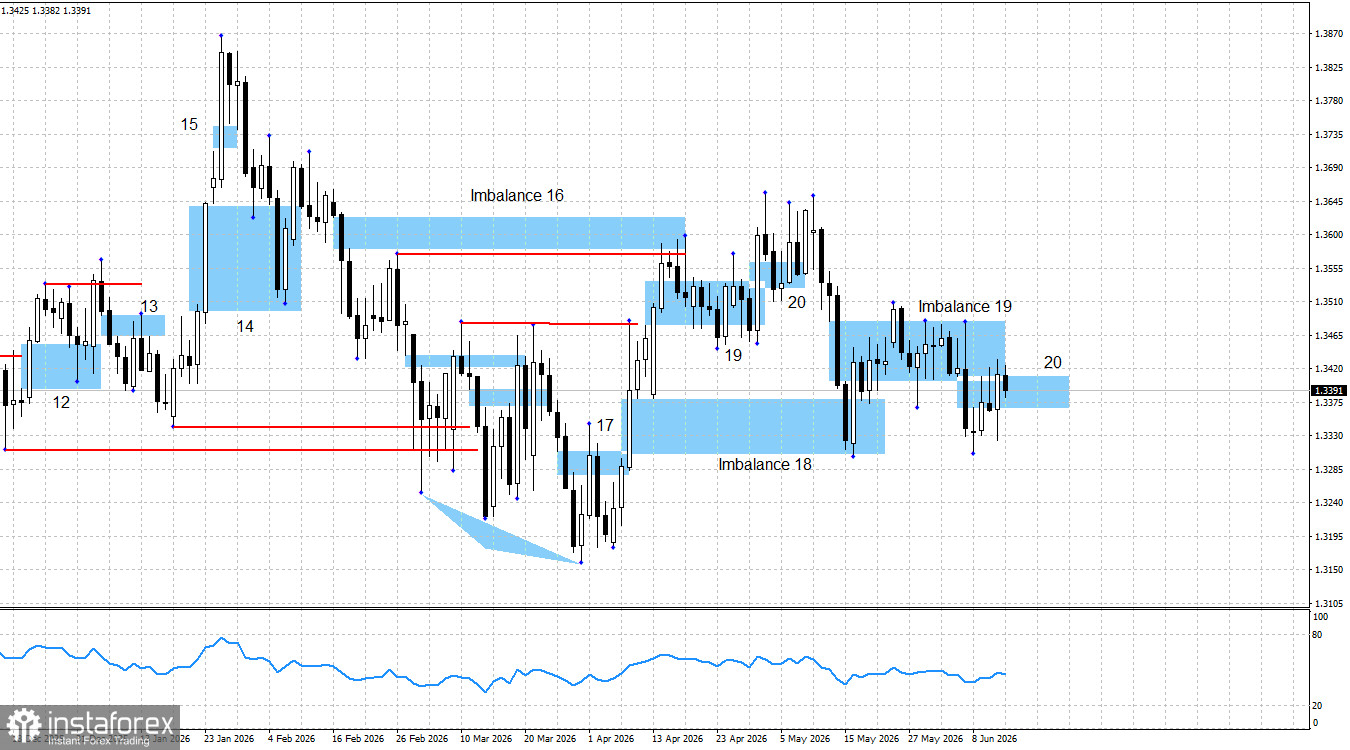
The GBP/USD pair has an excellent opportunity to continue its decline after reacting to bearish imbalance 19, but geopolitical developments have been changing direction twice a day this week. Therefore, even if a trade setup appears highly attractive at the moment, it is too early to celebrate. Within a few hours, Donald Trump may make a statement that sends the price sharply in the opposite direction. A few hours later, it may reverse again as Trump's position changes once more.
Yesterday morning, the U.S. president was preparing to launch significant strikes against Iran and accused Tehran of deliberately delaying negotiations. By the evening, however, "Middle Eastern leaders had reportedly persuaded Trump not to strike Iran because a deal was already close to completion."
Why Trump was planning new missile strikes on Friday if the deal was supposedly "nearly finalized" is a question no one can answer. Nevertheless, headlines continue to flood the market, and traders increasingly struggle to determine what—and whom—to believe.
Yesterday, GBP/USD was preparing to generate a sell signal within imbalance 20, while the euro was also positioning for renewed bearish pressure. Geopolitical developments favored a stronger dollar, and the technical picture pointed to further downside. However, Donald Trump changed the situation by the evening. How many more times his position may change over the remainder of Friday and throughout the weekend remains anyone's guess.
Fortunately, the currency market is closed over the weekend, so the next analysis will be conducted on Monday.
The situation in the Middle East is becoming increasingly tense, regardless of what anyone may claim. I do not expect the U.S. dollar to experience gains comparable to those seen between January and March, but it is difficult to deny that the dollar performs much better under conditions of geopolitical uncertainty than either the euro or the pound.
Therefore, while a major dollar rally may be unlikely, meaningful appreciation of the euro and the pound also appears difficult under the current geopolitical circumstances.
In my view, the long-term trend remains bullish despite the pair's substantial declines this year. At present, the ceasefire in the Middle East exists largely in name only. The Strait of Hormuz remains effectively under dual restrictions, the nuclear issue remains unresolved, and any progress in negotiations can only be assessed through statements made by Donald Trump.
Iran continues to present a very different perspective and regularly contradicts the optimism expressed by the White House. The situation constantly shifts between improvement and deterioration. At this point, the market no longer knows what information to trust.
The technical picture is currently as follows. Bullish imbalance 18 generated a reaction, but imbalance 19 ultimately produced a sell signal as well. Following the sell signal from imbalance 19, another sell signal could emerge within imbalance 20.
Both geopolitical developments and technical analysis support further downside in the pair. Until at least one bearish pattern is invalidated or a bullish pattern is formed, I would not expect a sustained recovery in the pound.
Friday's economic data could have supported the bears if traders had paid any attention to the UK economic reports. However, the 0.1% decline in UK GDP in April failed to impress market participants, while industrial production growth of 0.0% can still be viewed as a relatively acceptable result under current conditions.
Overall, these reports were ignored, and the market remains focused on developments in the Middle East.
From a broader perspective, the overall fundamental backdrop still suggests continued long-term weakness in the U.S. dollar. The conflict between Iran and the United States does little to alter that view. Geopolitical tensions temporarily reminded investors of the dollar's safe-haven status for roughly two months, but the broader outlook for the U.S. currency remains less favorable.
If the U.S. economy gains momentum in 2026, the Federal Reserve resumes its monetary tightening cycle, and the conflict between the United States and Iran evolves into a prolonged confrontation, then the dollar could realistically target the 1.3100–1.3000 level against the pound.
However, in my opinion, the long-term outlook for the U.S. dollar cannot be fundamentally altered by a single strong Nonfarm Payrolls report, and the Federal Reserve has not yet signaled any readiness to resume policy tightening.
The June 15 economic calendar contains only one event, which I do not consider significant. Therefore, the impact of the economic backdrop on market sentiment on Monday is expected to be negligible.
For the British pound, the long-term outlook remains bullish. However, the most recently generated signal is a sell signal.
Therefore, in the near term, provided geopolitical developments do not interfere, bears may resume their advance toward the March 31 low at 1.3158.
A liquidity grab may occur around recent swing points, after which bulls could return to the market if geopolitical conditions become more favorable.
At present, it is difficult to imagine the conflict between the United States and Iran ending in the near future. As a result, the pound's upward potential remains fairly limited.


