
یہ بھی دیکھیں


 14.10.2026 08:45 AM
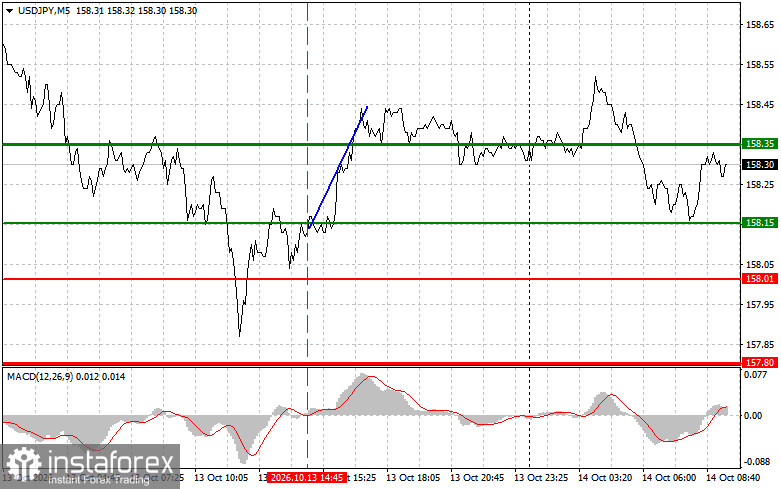
A price test at 158.15 occurred as the MACD indicator began moving up from the zero line, confirming a good entry point to buy the dollar. As a result, the pair rose toward the 158.35 target area.
The dollar weakened, giving the yen a chance to recover some ground. US data looked decent but did not provoke a strong reaction. The decisive factor was remarks by New York Fed president John Williams. He allowed for one more rate hike this year but saw no need for tightening in 2027, and expectations for further rate increases eased. This matters for USD/JPY because the policy gap between the Federal Reserve and the Bank of Japan remains the main driver of the exchange rate. Recall the BOJ raised rates to 1.25% at the September 18 meeting with a 7–2 vote, and the market prices in roughly a 25% chance of another move at the October 30 meeting.
Today's Japanese data were neutral. One measure of money supply grew 2.0% year-on-year in September versus a 2.1% forecast and 2.0% previously, while a second measure stayed at 1.2%, unchanged from before. A 0.1 percentage-point miss versus the forecast is not meaningful but indicates slow money-supply growth and no fresh liquidity boost yet. These indicators matter because they reflect bank lending activity and money in circulation, which indirectly influence inflation expectations and BOJ decisions. For the yen, these figures alone do not provide a strong impulse.
For the intraday strategy, I will mainly rely on Scenarios 1 and 2.
Scenario 1: Buy USD/JPY today near 158.35 (green line on the chart), targeting 158.63 (the thicker green line on the chart). Around 158.63, I plan to exit long positions and open short positions in the opposite direction (aiming for a 30–35 pip reversal from that level). It is best to return to buying the pair on corrections and significant pullbacks. Important: before buying, ensure MACD is above zero and only beginning to rise from it.
Scenario 2: Also consider buying if price tests 158.22 twice while MACD is in the oversold area. That would limit downside potential and trigger an upward reversal. Expect moves to 158.35 and 158.63.
Scenario 1: Plan to sell USD/JPY only after a break below 158.22 (red line on the chart), which should lead to a swift decline. Sellers' key target is 157.96, where I plan to exit shorts and immediately open longs in the opposite direction (aiming for a 20–25 pip reversal from that level). Sellers can return at any moment—you only need a hint from the central bank. Important: before selling, ensure MACD is below zero and only beginning to fall from it.
Scenario 2: Also consider selling if price tests 158.35 twice while MACD is in the overbought area. That would limit upside potential and trigger a reversal downward. Expect declines toward 158.22 and 157.96.
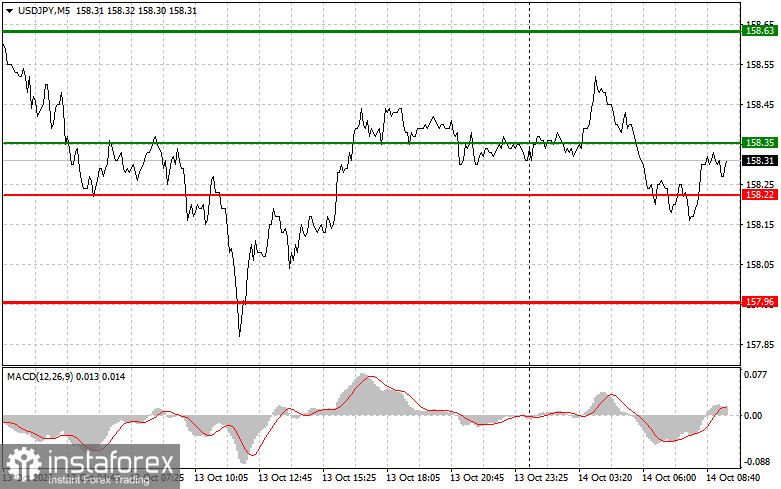
Thin green line — entry price where you can buy the instrument.
Thick green line — approximate price where you can place Take Profit or manually lock in profits, because further upside above this level is unlikely.
Thin red line — entry price where you can sell the instrument.
Thick red line — approximate price where you can place Take Profit or manually lock in profits, because further downside below this level is unlikely.
MACD indicator. When entering the market, it's important to consider overbought and oversold zones.
Important. Novice Forex traders must be very cautious when deciding to enter the market. It is best to stay out before major fundamental reports to avoid getting caught in sharp price swings. If you decide to trade during news releases, always place stop orders to minimize losses. Without stop orders, you can quickly lose your entire deposit, especially if you don't use money management and trade large volumes.
Remember: successful trading requires a clear trading plan, like the example above. Spontaneous trade decisions based solely on the immediate market situation are, by definition, a losing strategy for an intraday trader.


