
یہ بھی دیکھیں


 07.08.2026 09:40 AM
The dollar reacted positively to the news that the weekly number of initial jobless claims in the US totaled 199,000. The previous week's figure was revised upward by 1,000, from 197,000 to 198,000. The four-week moving average, which smooths weekly volatility, decreased notably to 198,750 from the revised 203,250, a loss of 4,500.

Particularly illustrative is the comparison with last year. In the corresponding week of 2025, the initial claims, adjusted for seasonal variations, stood at 226,000, which is 27,000 more than the current level. Without seasonal adjustment, the picture is even clearer: the actual number of claims was 171,246, compared to 195,492 a year earlier, a decrease of 5,289, or 3.0 percent, while seasonal factors suggested a decline of 5,752, or 3.3 percent.
The regional breakdown revealed significant discrepancies between states. The largest reductions in initial claims for the week ending July 25 were recorded in Michigan (-2,644), New York (-1,952), New Jersey (-1,377), Indiana (-1,340), and California (-1,313). In contrast, increases in claims were recorded on a much smaller scale: Ohio (+629), Vermont (+347), Iowa (+111), Nevada (+64), and Maine (+49). Notably, no state saw an increase exceeding 1,000 claims.
The picture emerging from these weekly data sharply contrasts with the hiring figures from the ADP employment report for July. Private employers created only 44,000 new jobs, with over 80 percent of the growth coming from education and healthcare, which added 36,000 positions. In comparison, businesses with 1-19 employees contributed 27,000 jobs, more than half of the overall result.
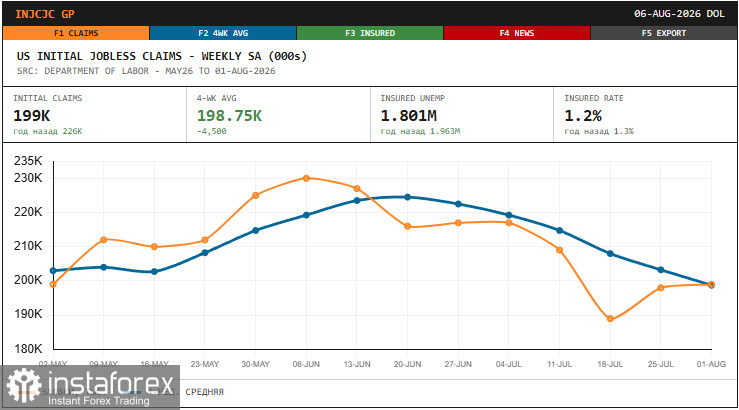
It is precisely the comparison between these two sets of data that reveals a key feature of the current American labor market. Employers are practically not laying off employees, as evidenced by minimal jobless claims and a declining four-week average. Still, they are also extremely cautious about creating new jobs, as shown by the modest ADP results. This regime of low layoffs amid low hiring creates a statistically stable but internally tense structure: unemployment does not rise since people are not being laid off, but finding new jobs becomes increasingly difficult. In areas where demand for specific skills remains, employers must significantly raise wages to attract candidates.


