
یہ بھی دیکھیں


 05.05.2026 07:04 PM
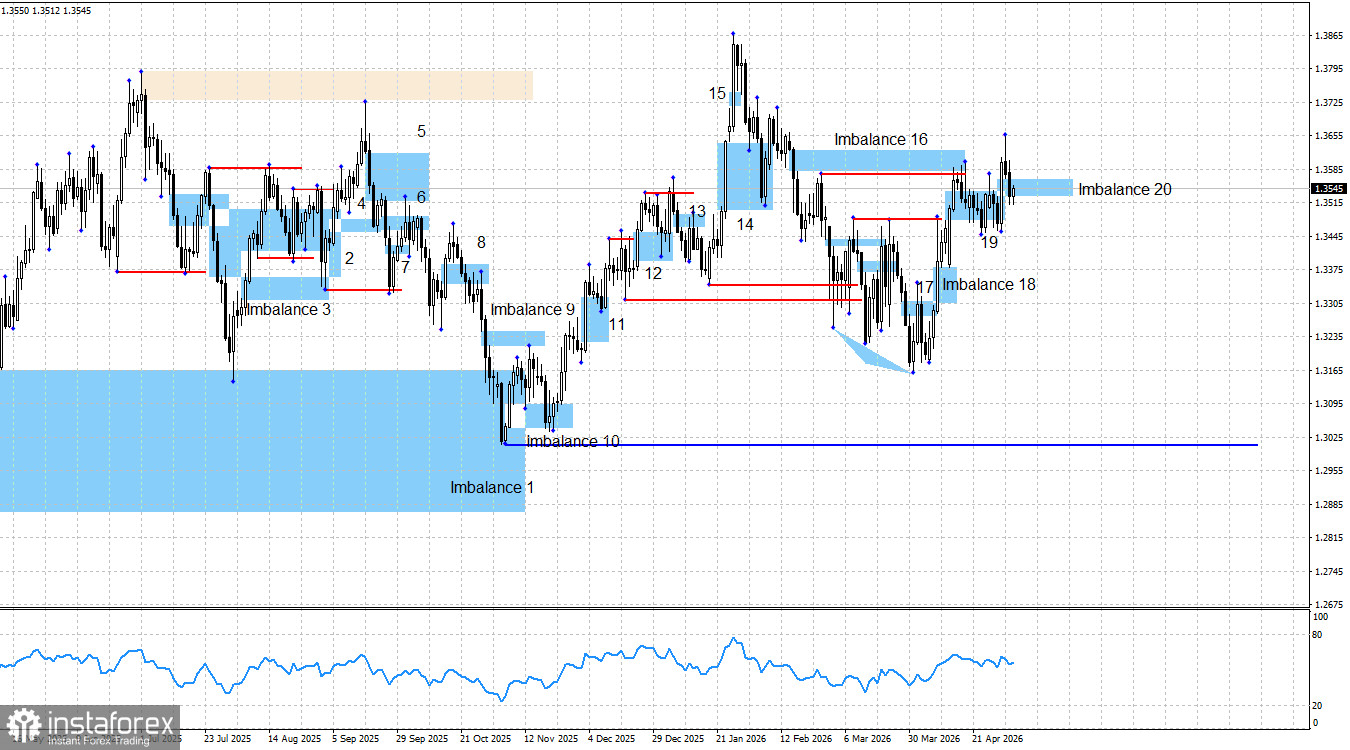
The GBP/USD pair reversed in favor of the pound within imbalance 19 and began rising last Thursday. Since then, prices have declined for the third consecutive day, driven by geopolitical developments. Recall that on Friday another attempt to "establish contact" between Tehran and Washington failed, and on Monday it was reported that Iran attacked a U.S. destroyer. This escalated tensions between the parties and led to new Iranian strikes on regional allies, which could trigger retaliatory actions in the coming days. As a result, the week could turn highly volatile.
This week, important U.S. labor market and unemployment reports are also due. However, if events in the Middle East continue to unfold with the same intensity, the market may largely ignore economic data. At present, Federal Reserve policy and economic indicators are not the primary focus for traders. For the pair to continue rising, Monday's events would need to prove to be a misunderstanding without further consequences. Iran and the United States have so far failed to agree on a peace plan that could lead to formal negotiations. A new escalation will not bring the two sides closer to an agreement.
There is little more to add regarding the news backdrop. The situation around resolving the Middle East conflict remains stalled, and traders are uncertain about the market's next direction. For now, bulls still hold the advantage, but if escalation continues, bears could launch a full-scale offensive.
The pound's rise initially began with a "Three Drives" pattern. This provided traders with a bullish signal at the early stage of the move, and the overall trend remains bullish. At present, the truce in the Middle East is fragile, and the parties involved have yet to decide whether to continue negotiations or resume hostilities. Talks may resume, but so could the conflict itself. The Strait of Hormuz remains effectively under dual pressure, while Tehran and Washington cannot even agree on a direct meeting between their delegations, let alone a comprehensive agreement to end the conflict. As of Tuesday, the situation has shown no improvement for the past two weeks. While both sides express willingness to reach a deal, in practice, missile strikes continue.
The "Three Drives" pattern marked on the chart (with a triangle) enabled bulls to take control. Imbalance 18 allowed traders to open long positions, and imbalance 19 provided another opportunity. As a result, three bullish signals were generated within the current impulse, and a new bullish imbalance 20 formed on Friday. Bearish patterns and liquidity sweeps have not significantly challenged the bulls. Only geopolitics could prevent further bullish advances in the coming days.
There was no significant economic news on Tuesday. Around this time, ISM and JOLTS reports are expected in the United States, so the final part of the trading day may be more active than the earlier sessions.
In the U.S., the broader fundamental backdrop still suggests limited long-term upside for the dollar. Even the conflict between Iran and the United States does little to change this. Geopolitical tensions have temporarily revived the dollar's safe-haven appeal for about two months, but the long-term outlook remains challenging. The U.S. labor market continues to weaken, the economy is approaching recession, and the Federal Reserve—unlike the ECB and the Bank of England—is not expected to tighten monetary policy in 2026. In addition, several large-scale protests against Donald Trump have taken place across the country, and the eventual departure of Jerome Powell could further weigh on the dollar, particularly if the FOMC adopts a more dovish stance under new leadership. From an economic perspective, there are currently few reasons to expect sustained dollar strength.
Economic Calendar (U.S. and UK):
U.S.: ADP Employment Change (12:15 UTC)
On May 6, the economic calendar includes only one release, which is not considered a key labor market indicator. As a result, the impact of the news flow on market sentiment on Wednesday may be minimal.
GBP/USD Forecast and Trading Advice:
The long-term outlook for the pound remains bullish. The "Three Drives" pattern signaled the beginning of the upward move, followed by three additional bullish patterns and two bullish signals. Under the current conditions, despite geopolitical risks, further growth in the pound is expected. However, geopolitics could still disrupt the bullish outlook.
The target for the pound is the 2026 high. A reaction to imbalance 16 triggered a corrective pullback, while the reaction to imbalance 19 provided a new buying opportunity. At present, a reaction to imbalance 20 may offer traders another bullish signal.


