
Lihat juga


 23.10.2026 08:09 PM
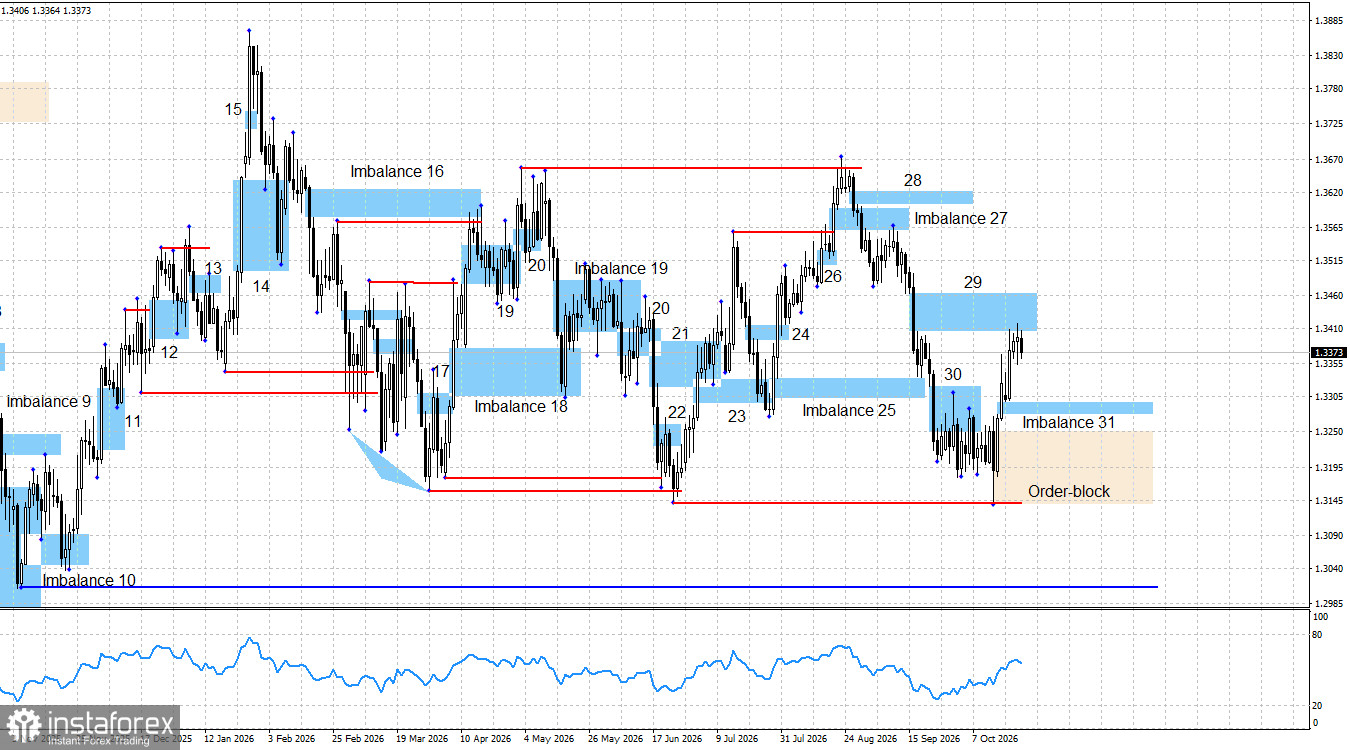
The GBP/USD pair began rising after taking liquidity from the latest bearish swing and has since gained 260 points. The pound posted solid gains for five consecutive days, invalidating Imbalance 30. This is the first step toward the formation of a bullish trend. In addition, a bullish Order Block and bullish Imbalance 31 have formed. The technical picture appears to be shifting rapidly in a bullish direction.
The fundamental backdrop has also favored the pound this week. Unemployment has declined, inflation has increased, and the Bank of England is expected to tighten policy in two weeks. The market has not yet priced in any Bank of England monetary policy tightening, unlike the Federal Reserve's tightening, which has already been more than fully priced in. There appears to be little to prevent a further bullish move. Imbalance 29 halted the bulls' advance. As expected, the pattern triggered a reaction, so a corrective pullback may now begin. This would be a favorable development for the bulls, as it could allow one of the two bullish patterns to play out and generate buy signals.
Another important factor for the pound's outlook is that traders expect the Bank of England to tighten monetary policy three times, compared with just one or, at most, two tightenings by the Federal Reserve. The Fed's dot plot also points to one rate hike, while the latest FOMC minutes confirmed that most policymakers expect only one increase. Of course, the outlook for 2027 remains uncertain, but this is the current consensus forecast. As a result, the Bank of England could ultimately raise interest rates more aggressively than the Fed over the coming months, which would be unlikely to support further gains in the US dollar. The dollar has already benefited substantially from expectations of Fed tightening; the market may now begin to price in the Bank of England's tightening cycle.
If the Fed had not raised interest rates in September and signaled its willingness to continue tightening monetary policy, a decline in the US dollar would have been expected a month ago. That expectation remains in place. The pair has reversed in favor of the pound, and the next step is to form bullish signals that traders can use to open long positions. The pound's long-term outlook remains bullish.
Do the bears have any further downward potential? In my view, it is limited. Over the past six to eight weeks, the bears appear to have achieved an exceptional move, pushing the dollar to levels that are high by recent standards. It is worth recalling that the market has had reasons to buy the dollar recently, but there have also been reasons for the pound to appreciate that traders have largely overlooked. A reversal may now begin, and this move could be more consistent with the underlying fundamentals than the preceding decline.
Friday's economic data gave the bulls an opportunity to resume their advance, but ultimately they mainly prevented the bears from gaining ground. The UK services and manufacturing activity reports came in stronger than market expectations, making it difficult for the bears to press their advantage. The only report that supported the bears was the retail sales release, which showed a 0.4% month-on-month decline. Even so, the bears struggled to mount an effective move. The corrective pullback may continue next week.
The overall fundamental backdrop remains such that, over the long term, a decline in the US dollar appears to be the most likely direction. The war between Iran and the United States has not changed this outlook. Geopolitical tensions prompted the market to refocus on the dollar's safe-haven status for several months, but the conflict has already passed its most acute phase. The FOMC's future monetary policy remains uncertain, while the market continues to anticipate tightening, which is the main factor behind the bears' confidence. However, traders are still overlooking the prospect of Bank of England monetary policy tightening. Inflation is rising in the UK, as it is around the world, leaving the Bank of England with little choice but to raise interest rates as well.
On October 26, the economic calendar contains no significant releases. The economic backdrop is therefore unlikely to affect market sentiment on Monday.
The pound's long-term technical outlook remains bullish. The bears controlled price action in recent weeks, but the broader range is clearly visible on the daily chart. The liquidity sweep below the swing low from May 1 triggered a decline within the horizontal range. However, liquidity was also swept below the June lows, allowing the bulls to regain control.
Therefore, the short-term technical picture has now turned bullish. For traders, this means that the preferred approach in the near term is either to maintain existing long positions or to look for new buying opportunities. Potential entry points may emerge at the Order Block or Imbalance 31. However, a corrective pullback will be needed before new signals form. The pound's target is near the upper boundary of the range at 1.3670. The reaction to Imbalance 29 could trigger the corrective pullback needed for this setup.


