
Lihat juga


 24.03.2026 01:41 PM
The euro fell after news that the eurozone PMI dropped to a 10?month low, and stagflation risks have increased.
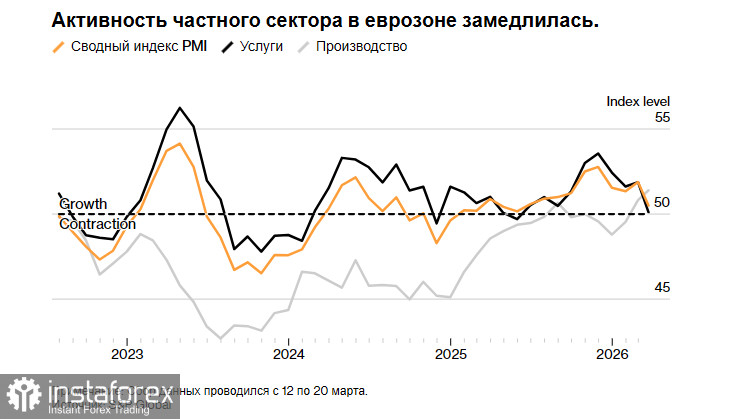
Data shows private sector business activity in the euro area is expanding at the slowest pace since May last year, as the war with Iran fuels inflation and threatens the region's nascent economic recovery.
The S&P Global composite purchasing managers' index fell to 50.5 in March from 51.9 in the prior month, though it remained above the 50 threshold separating expansion from contraction. Analysts had expected a decline to 51.
Inflationary pressure from higher energy and commodity prices driven by the escalation is the main threat to further recovery. Record oil and gas prices could depress consumer demand and investment activity, worsening the slowdown. That puts the European Central Bank in a difficult position. On the one hand, high inflation argues for tighter monetary policy. On the other hand, slowing growth and rising living costs mean further rate hikes could be damaging.
In Germany, the region's largest economy, the composite PMI fell more than expected but remained above 50. In France, the picture is worse: for the third month, the index has remained below that level. The services sector was the weak link in both cases, while manufacturing performed better.
"Preliminary eurozone PMI data ring alarm bells about stagflation as the Middle East war is sharply pushing up prices while holding back growth," S&P Global Market Intelligence said. "Companies' costs are rising at the fastest rate in three years amid a sharp rise in energy prices and supply chain disruptions caused by the war."
Clearly, fighting in the Middle East threatens an already modest growth outlook, and markets expect that taming a new surge in inflation will require higher interest rates. The eurozone's prospects — and the euro's strength — depend on the duration of the war and any potential long-term damage to energy supplies and supply chains.
After today's data, it became evident to many that the eurozone economy and the ECB are no longer well-positioned on both growth and inflation, which may limit the euro's upside in the medium term.
Technical outlook on EUR/USD
Buyers now need to reclaim 1.1615. Only that will allow a test of 1.1638. From there, the currency pair could climb to 1.1669, but doing so without support from major players will be difficult. The more distant upside target is 1.1705. On the downside, I expect significant buyer interest only around 1.1588. If there is no buying activity there, it would be prudent to wait for a new low at 1.1554 or to open long positions from 1.1526.


