
Lihat juga


 31.01.2026 07:48 PM
Today, the US entered its second "shutdown" during Donald Trump's second presidency.
Many analysts call it "partial," but personally, I don't understand that term, since critically important government agencies continue to operate during any shutdown. A shutdown itself causes far less economic damage than, say, a trade war, although that claim can be debated if you look at recent GDP growth rates for the last two quarters. On paper, everything may look fine, but I cannot imagine a trader who would count a shutdown as a positive for the dollar.
Let me address one important point right away. The US currency strengthened steadily on Wednesday, Thursday and Friday, which could mislead some traders. It might give the impression that the market has priced in all the negatives, that Trump's military interventions are a "positive," that the new Fed chair will deliver hawkish decisions, and that traders now see some upside in the trade war. I believe that view is wrong. This week, I said that five?wave upward structures on both instruments were approaching completion. Therefore, I expected a decline. I believe that decline is simply the market building a corrective wave structure.
Back to the shutdown. The Senate managed to approve funding for almost all agencies through September 2026, but now the bills must be passed by the House of Representatives. That should not be a problem, since both chambers have Republican majorities. The House could vote as early as Monday, and the shutdown would end.
I should remind readers that the market's reaction to the first shutdown was almost non?existent, so most likely participants will hardly notice this second shutdown either. The news flow is so abundant and broad right now that one inevitably has to separate the important from the unimportant. A shutdown is probably in the "unimportant" category. Much greater significance lies in a possible US strike on Iran, which is unlikely to be focused purely on military or nuclear targets. What form it would take and what its objectives would be — nobody knows. Recall that Tehran did not accept the nuclear deal, so Trump needs a new government to reach an arrangement.
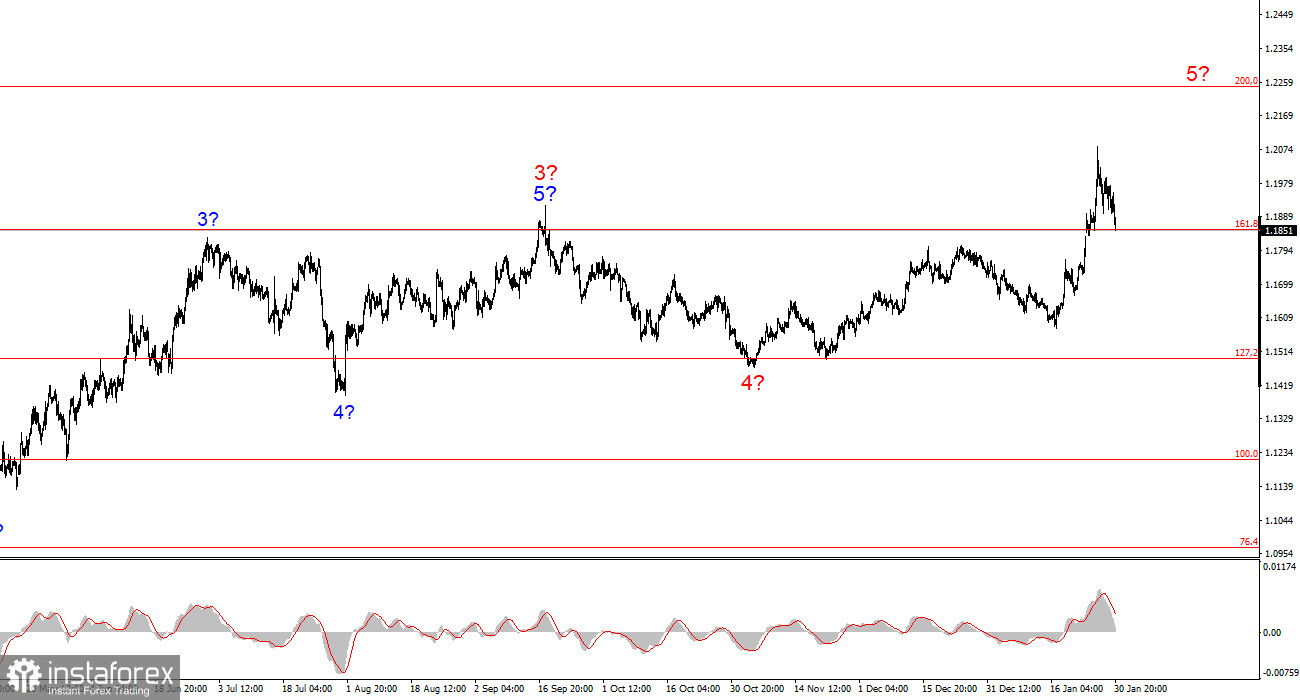
Based on my EUR/USD analysis, I conclude the instrument is still building an upward phase of the trend. Donald Trump's policies and Fed policy remain meaningful drivers of long?term dollar weakness. Targets for the current leg could extend all the way to the 1.25 area. At the moment, I believe the global Wave 4 has completed, so I expect further price rises. But in the near term, I expect a downward wave, since the a?b?c?d?e series also appears complete. In the coming days, readers can begin looking for levels to enter new long positions.
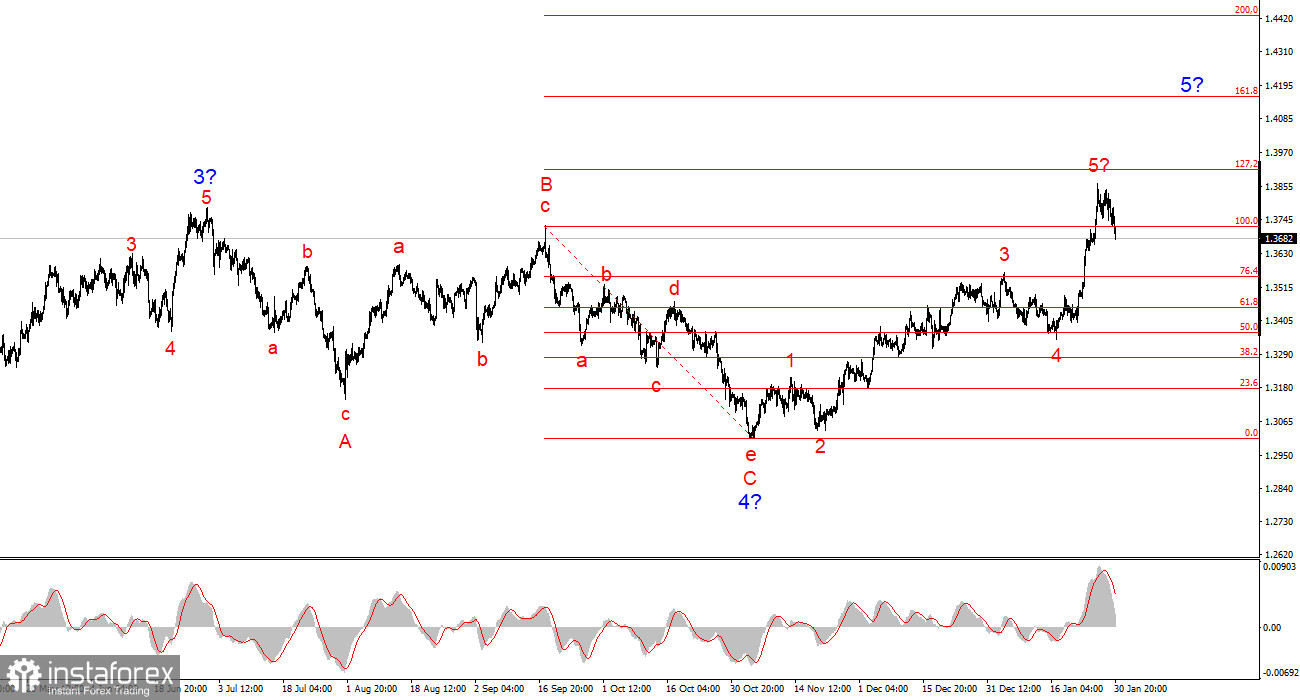
The wave structure of GBP/USD looks reasonably clear. A five?wave upward structure has completed, although the global Wave 5 may turn out to be much more extended. I think the current upward sequence is approaching completion or may already be complete. Consequently, a corrective phase or sequence of corrective waves may begin soon, after which the main uptrend will likely resume. Therefore, in the next few weeks, I may advise looking for buying opportunities. In my view, under Donald Trump, the pound has a chance to trade in the $1.45–1.50 range. Trump welcomes a weaker dollar. In his view, his actions yield a double positive effect: a lower dollar and progress on domestic, external, trade and geopolitical issues.
Key principles of my analysis:


