
Lihat juga


 15.12.2025 07:15 PM
For GBP/USD, the wave count continues to indicate the formation of an upward trend segment (bottom chart), but over the past few weeks it has taken on a complex and extended form (top chart). The trend segment that began on July 1 can be considered wave 4, or any global corrective wave, as it clearly has a corrective rather than impulsive internal wave structure. The same applies to its internal sub-waves. The downward wave structure that started on September 17 took the form of a five-wave pattern a–b–c–d–e and has been completed. The instrument is now in the process of forming a new upward wave sequence.
Of course, any wave structure can become more complex and extended at any time. Even the presumed wave 4, which has been forming for six months already, could take on a five-wave structure, in which case we would observe a correction for several more months. However, at the present time there are good chances for the formation of an upward wave sequence. If this is indeed the case, the first two waves of this segment have already been formed, and we are now observing the development of wave 3 or c, which is taking on an impulsive character and gives hope that the current wave sequence is impulsive in nature.
The GBP/USD pair barely moved on Monday, but the most interesting events are ahead tomorrow. On Tuesday, the UK will release reports on the claimant count, the unemployment rate, average earnings, and business activity in both the services and manufacturing sectors. It is difficult to imagine which of these publications could support demand for the British currency, given the economic data of the past couple of months. The vast majority of reports over this period have come in weaker than market expectations, so the situation may repeat itself tomorrow, leaving the pound under market pressure.
However, the dollar could also come under pressure. On Tuesday, the United States will release even more important reports on the labor market, unemployment, and business activity. The business activity indices can be largely ignored, but it will be impossible to overlook the Nonfarm Payrolls report and the unemployment rate. These two releases could trigger such a market reaction that even the morning UK statistics may become irrelevant. Most interestingly, it is also very difficult to expect positive surprises from the U.S. data. Of course, these reports will not disappoint every time, but only results that are better than market expectations can support the dollar. This is a more achievable task, but it still has to be met. Therefore, on Tuesday both currencies may take a beating from market participants.
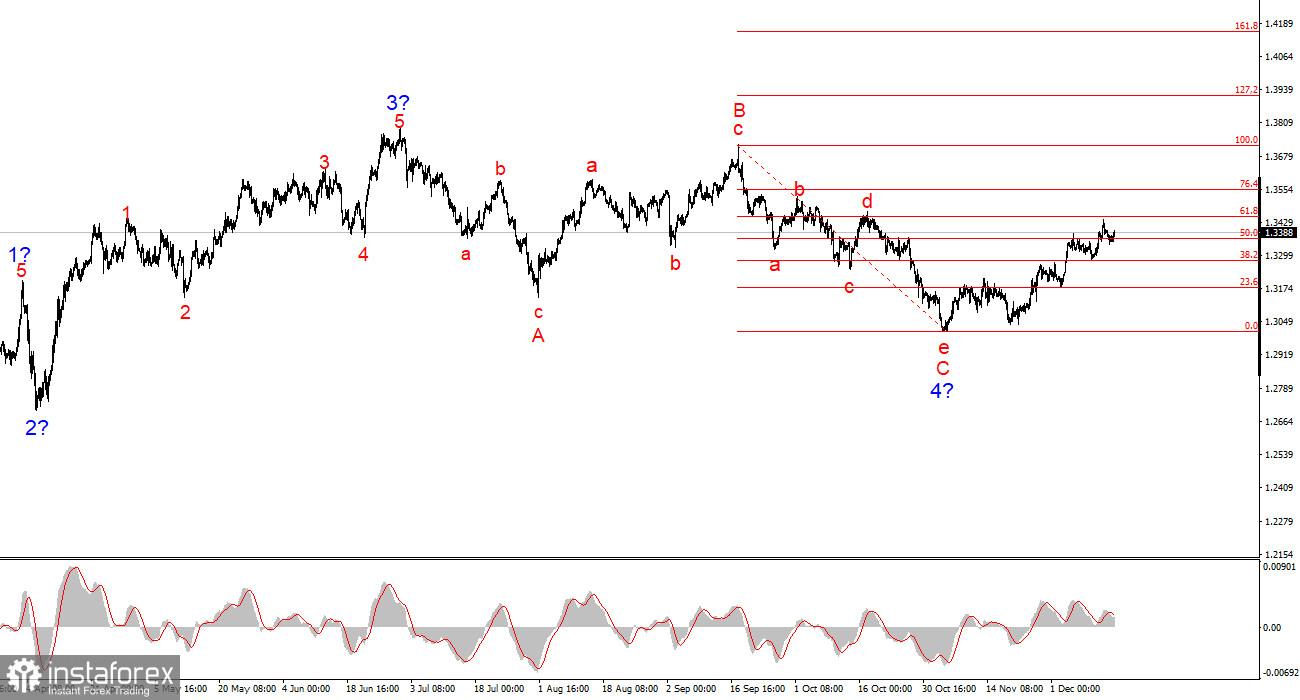
The wave picture for GBP/USD has changed. We are still dealing with an upward, impulsive segment of the trend, but its internal wave structure has become complex. The downward corrective structure a–b–c–d–e within wave C of wave 4 appears to be complete, as does wave 4 as a whole. If this is indeed the case, I expect the main trend to resume its development with initial targets around the 1.38 and 1.40 levels.
In the short term, I expected the formation of wave 3 or c with targets near 1.3280 and 1.3360, corresponding to the 76.4% and 61.8% Fibonacci levels. These targets have been reached. Wave 3 or c continues to develop, and the current wave sequence is beginning to take on an impulsive character. Consequently, further gains can be expected, with targets located around 1.3580 and 1.3630.


