
यह भी देखें


 05.10.2026 06:51 PM
The wave count on the 4-hour EUR/USD chart is becoming more complex. There is still no question of invalidating the upward section of the trend (lower chart), which began in January last year. On the contrary, we have seen a complete A-B-C corrective structure, which could have been completed. However, recent developments related to the Fed and its monetary policy have once again affected the current wave structure, making the wave count more complex. It should be noted that the fundamental backdrop and wave count often conflict with each other, making adjustments necessary.
The wave count has now developed into a more complex structure. Wave C has taken a three-wave form, while the next wave is identified as wave D. The entire trend section that began on January 27 could take the form of a five-wave corrective structure A-B-C-D-E. If this assumption is correct, wave D has been completed, and on August 21, EUR/USD entered the phase of forming wave E, whose low should be below the low of wave C at 1.1325. The pair is only a short distance away from this level, and below it, the presumed wave E could complete its formation at any time.
The EUR/USD pair declined by another 90 points during Monday's trading session but managed to recover by 60 points during the day. However, these 60 corrective points do not even appear to represent the beginning of a corrective wave. The current wave count has long suggested the formation of a corrective upward wave or a new upward wave sequence, but selling of the euro and buying of the dollar continue, so the instrument continues to decline.
Monday can reasonably be described as another difficult day for the European currency. Over the weekend, the official government of Yemen declared war on the Houthi militant group, which controls a significant part of the country, including its capital. As a result, another war has begun in the region. This raises questions about the effectiveness of diplomatic efforts to resolve international disagreements, given the frequency with which armed conflicts have emerged in recent years.
The fact remains that a new war has begun in the Middle East, and it could become linked to the existing conflict or develop into a broader conflict. The Bab el-Mandeb Strait has been under the risk of disruptions similar to those affecting the Strait of Hormuz for several months, so conditions in the energy market are not improving, while investor sentiment is also not improving. Investors have once again reduced exposure to risks associated with the fiscal problems of many major economies, extremely high levels of public debt, and armed conflicts, so demand for the US currency remains consistently high. This suggests that the US currency may continue to appreciate, even though such a scenario would have been difficult to anticipate only a month ago. However, significant market-moving events have remained frequent in recent years, and the market is therefore required to respond to them.
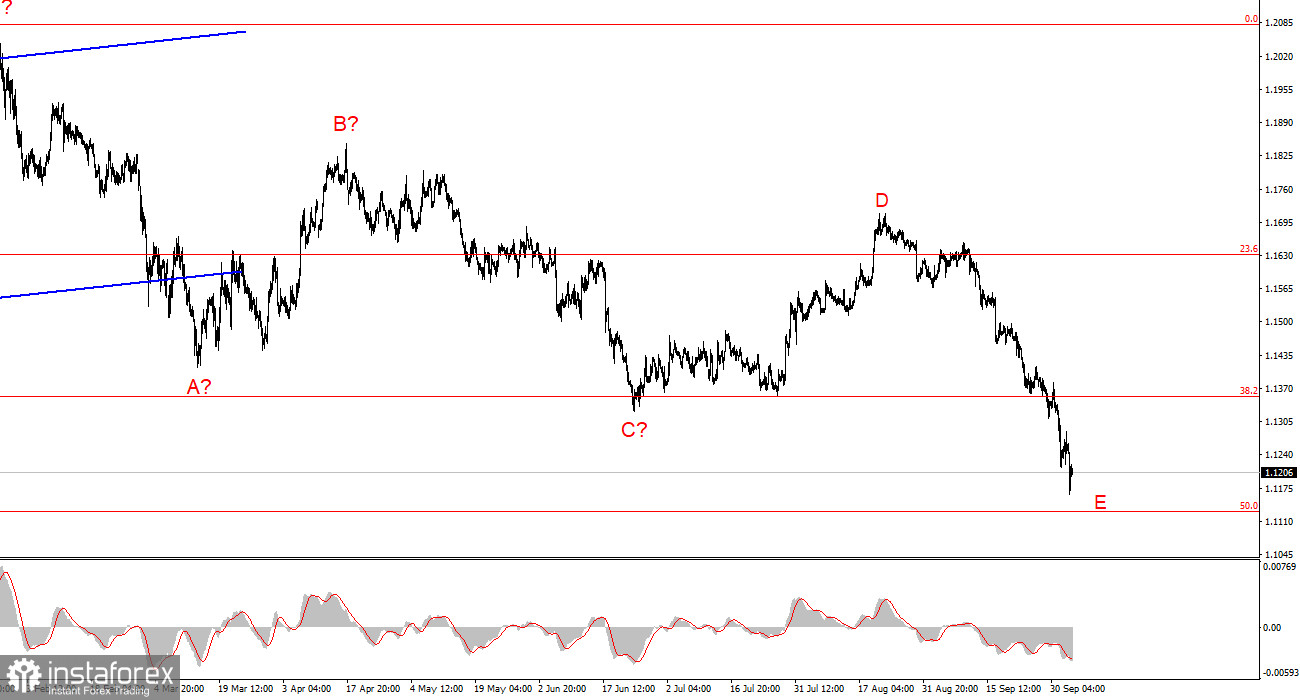
Based on the EUR/USD analysis, I conclude that the pair remains within a global corrective trend section A-B-C-D-E. If this assumption is correct, the decline in quotes will continue toward targets below the low of wave C at 1.1325. I previously considered this scenario to be an alternative scenario, and without the Fed meeting, it would have remained a secondary scenario. However, the Fed delivered an unexpected outcome, leaving the market with few alternatives other than another wave of US dollar buying. Nevertheless, these purchases have already continued for several weeks, even though there are no new fundamental factors supporting the dollar. I would not open short positions against such a fundamental backdrop and would instead prepare for a potential reversal.
On the higher timeframe, a downward trend section can be seen taking the form of A-B-C-D-E. Therefore, EUR/USD may continue declining below the low of wave C, while the internal wave structure of wave E may take the form of a five-wave impulse.

