
यह भी देखें


 31.01.2026 10:33 AM
Both Ethereum and Bitcoin have again suffered a sharp decline this week. In essence, the latest crypto market crash began on Thursday when news emerged about the new Federal Reserve chair. It appears to be Kevin Warsh. All financial markets reacted rather strangely to the unexpected Fed chair candidate. Many had expected Christopher Waller or Kevin Hassett to be appointed. But Trump once again made a surprising move and "outplayed" everyone.
Why did the market collapse? That's hard to answer, because Warsh is not known as a fervent advocate of "tight" monetary policy. Recall that tight monetary policy can put pressure on risk assets because rates stay high, and safe investments (bank deposits, Treasuries) yield more. As a result, some capital shifts from high?risk assets to safe havens. Under a dovish monetary policy, everything works the opposite way: lower interest rates make safe assets less attractive and increase demand for risky assets.
So, Warsh would almost certainly follow a relatively "dovish" policy stance. Otherwise, he could not have become the main candidate for Fed chair. Trump wants low interest rates. If Warsh were not prepared to support Trump's views, his candidacy wouldn't have been considered. From that, it follows that markets should have reacted to Warsh's nomination with gains, not declines. However, in reality, we saw a sell?off across gold, silver, stocks, various metals, and cryptocurrencies. This suggests market makers staged another manipulation and used the Warsh appointment as a pretext for a mass liquidation.
Trading recommendations
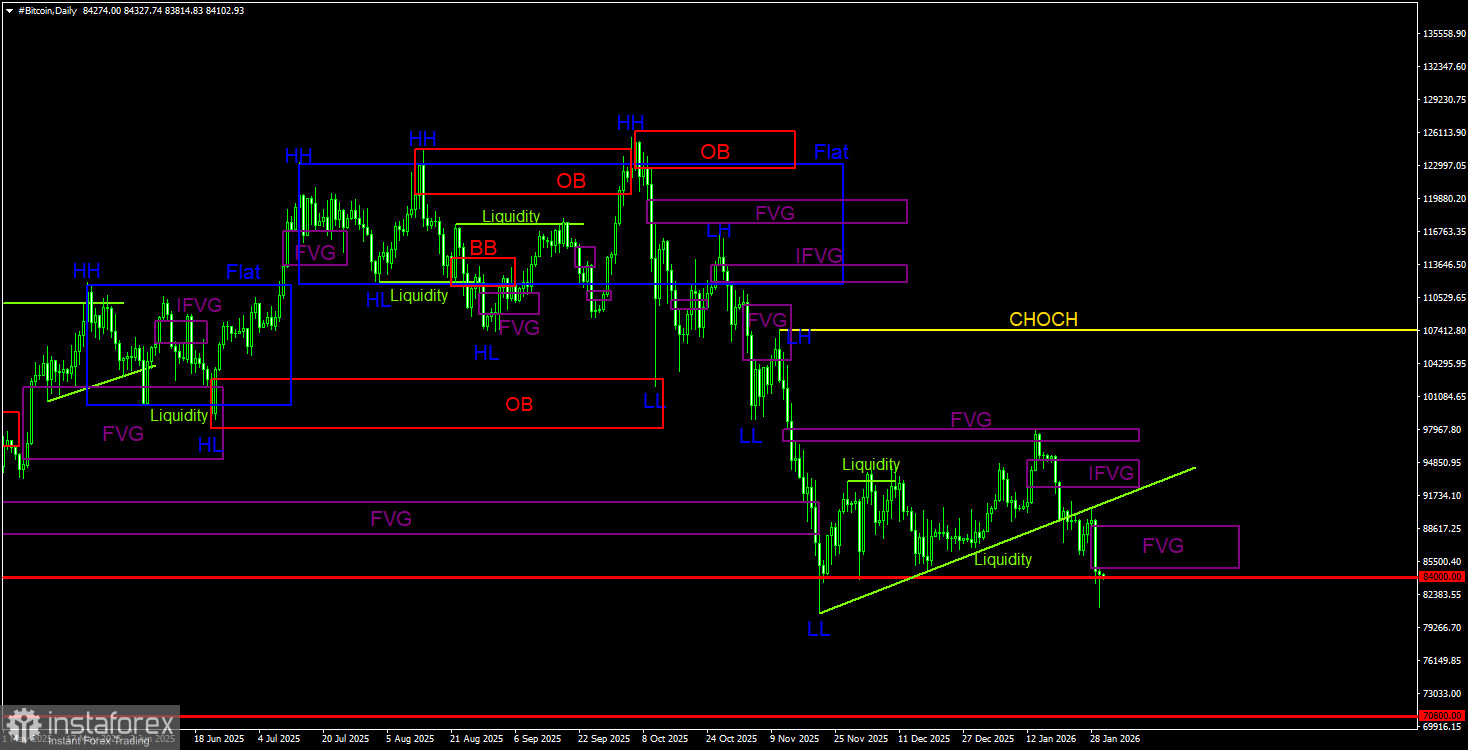
Bitcoin continues to follow a full-fledged downtrend. In the near term, we expect a fall toward $70,800 (the 50.0% Fibonacci level of the three?year uptrend). New POI sell areas on the daily timeframe include a bearish IFVG in the $92,500–95,000 zone. The price may return to that pattern and resume the decline from it. On the 4?hour timeframe, a bearish FVG has also formed, which could provide opportunities to open new shorts.
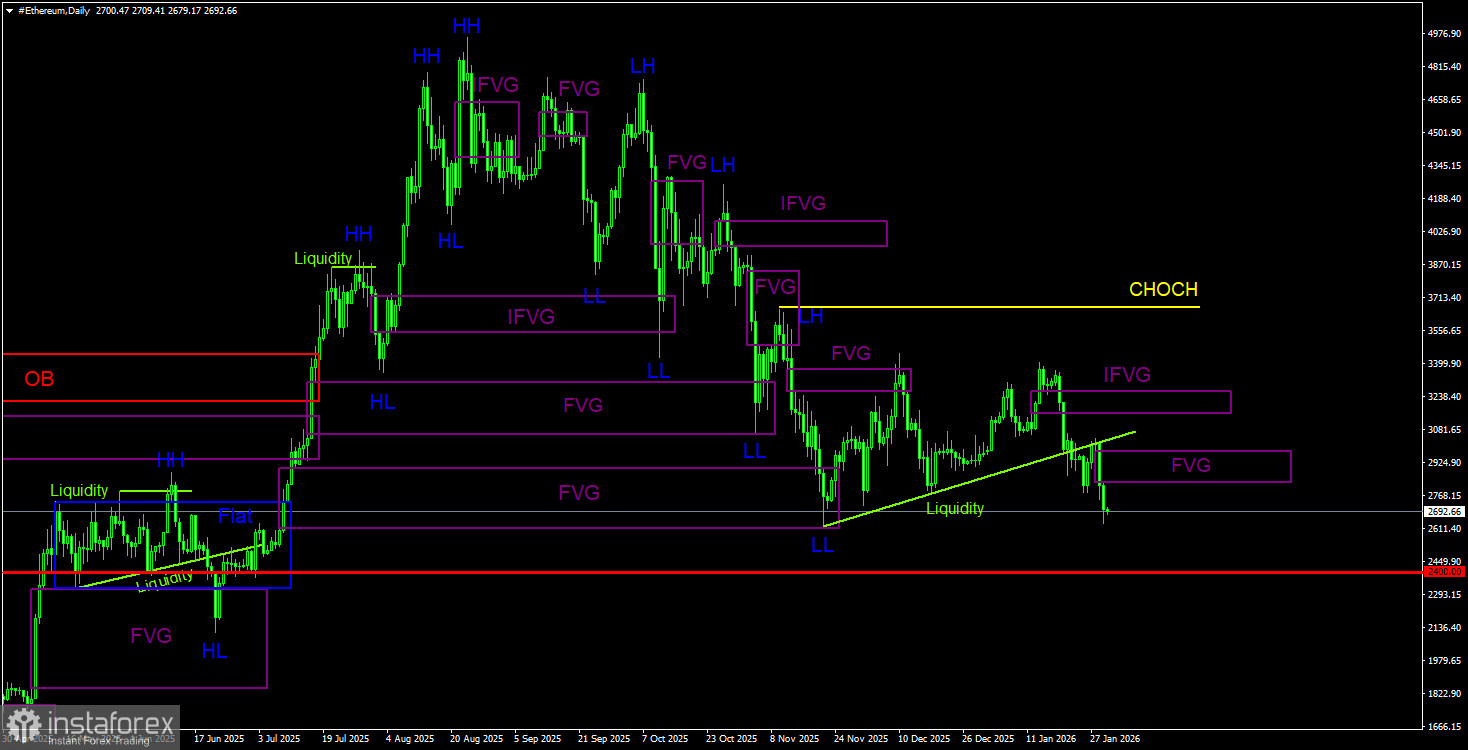
On the daily timeframe, the downtrend is still going on. The key sell pattern is the bearish order block on the weekly timeframe. The movement triggered by that signal should be strong and long?lasting. On the daily chart for Ethereum, there is a bearish FVG. On the 4?hour chart, there is a bearish FVG as well. From these two patterns, traders can consider opening new short positions. Downward targets of $2,618 and $2,400 remain relevant — and those are just the nearest targets. Ethereum's medium?term downside potential is much larger.
CHOCH — change of character/break of the trend structure. Liquidity — liquidity, traders' Stop Losses that market makers use to build their positions. FVG — Fair Value Gap (area of price inefficiency). The price often moves quickly through such areas, indicating the absence of one side in the market. Later, the price tends to return and react to these zones. IFVG — Inverted Fair Value Gap. After a return to such a zone, the price does not react, but impulsively breaks through and then tests it from the other side.
OB — Order Block. A candle on which a market maker opened a position in order to harvest liquidity and then form their own position in the opposite direction.

