
See also


 09.06.2026 06:50 PM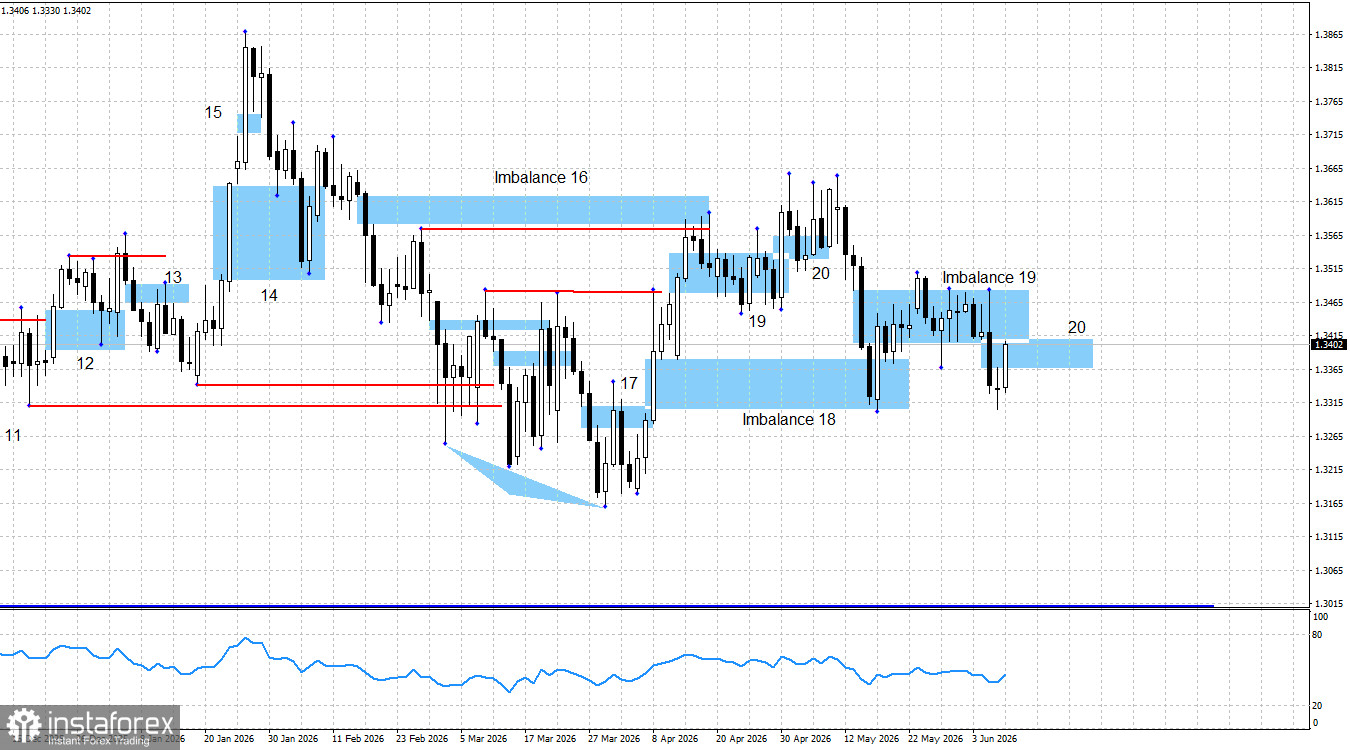
The GBP/USD pair has an excellent opportunity to continue its decline after reacting to bearish Imbalance 19 following two weeks of trading within it. However, the situation is not as straightforward as it may seem.
Following Friday's decline triggered by the Nonfarm Payrolls report, a new bearish Imbalance 20 was formed. Today, price has completely filled this imbalance, and at the current pace of bullish pressure, it may soon be invalidated. If that happens, the bearish move will be interrupted before it has even properly begun.
Once again, traders will be reminded of how quickly conditions can change both in the currency market and in the Middle East. Today, the market sold the U.S. dollar, apparently in response to renewed optimistic comments from Donald Trump regarding a potential resolution of the conflict, as well as reports of a ceasefire between Israel and Iran.
It is difficult to determine who in the market is still willing to believe that an agreement between Tehran and Washington is imminent. Military actions between Israel and Iran could resume just as quickly as they stopped. Therefore, the coming weeks are likely to bring numerous geopolitical reversals in price action.
If Imbalance 20 is invalidated, no active trading pattern will remain. I would like to remind traders that opening positions from an area of interest requires more than simply a reaction from that zone—a valid signal must form within it. In other words, a sell signal inside Imbalance 20 may never materialize.
Overall, the situation surrounding the Middle East conflict is better than it was a few months ago when the parties were engaged in full-scale military confrontation. Nevertheless, the pendulum can swing in the opposite direction at any moment.
Over the past several weeks, we have witnessed numerous potential escalations in the Middle East, and only the reluctance of both sides to resume large-scale military operations has prevented the conflict from reigniting.
In my view, the broader trend remains bullish despite the pair's significant declines this year. The ceasefire in the Middle East remains fragile, but it is still in place and may be extended for another 60 days.
However, the Strait of Hormuz remains effectively blocked from both sides, the nuclear issue remains unresolved, and any assessment of progress in negotiations is based largely on statements from Donald Trump. Iran continues to present a very different interpretation of the situation.
Conditions continue to shift between improvement and deterioration. For now, the market retains some confidence that an agreement can eventually be reached, but that confidence is not unlimited.
The current technical picture is as follows. Bullish Imbalance 18 generated a valid price reaction, while Imbalance 19 eventually produced a sell signal. However, only two days after that signal appeared, bullish rather than bearish pressure emerged.
The reason is that the geopolitical backdrop has shifted once again. As a result, technical patterns continue to trigger frequent reversals, while traders often struggle to react quickly enough to rapidly changing developments.
There was no significant economic news on Tuesday. Market participants reacted positively to Trump's latest promises to reopen the Strait of Hormuz and thereby reduce oil prices, although in my opinion these promises have little connection to reality.
Nevertheless, Iran and Israel have suspended military operations, which is certainly a positive development. The situation remains unstable and highly unpredictable.
The broader fundamental backdrop still leads me to expect continued long-term weakness in the U.S. dollar. Even the conflict involving Iran and the United States changes little in that regard.
Geopolitical developments temporarily reminded investors of the dollar's safe-haven status for roughly two months, but the overall environment for the U.S. currency remains unfavorable.
If the U.S. economy gains momentum in 2026, the Federal Reserve resumes its monetary tightening cycle, and tensions between the United States and Iran evolve into a prolonged conflict, then the dollar could realistically target the 1.3100–1.3000 level against the pound.
However, in my view, the long-term outlook for the U.S. dollar could not have fundamentally changed because of a single strong Nonfarm Payrolls report, and the Federal Reserve has not yet signaled any readiness to tighten monetary policy.
The economic calendar for June 10 contains one event, but it is an important one. The economic backdrop may have a noticeable impact on market sentiment during the second half of Wednesday's trading session.
The long-term outlook for the British pound remains bullish, although the most recently formed signal is a sell signal. Therefore, in the near term, provided that geopolitical developments do not interfere, bears may continue their advance toward the lows of May 18 and March 31. Liquidity could be taken from those swing lows, after which, if geopolitical conditions improve, bulls may regain control and resume the upward trend. At present, it is difficult to imagine a quick resolution to the conflict involving Iran and the United States, which limits the pound's upside potential. At the same time, the dollar repeatedly loses momentum as occasional positive developments continue to emerge from the Middle East.


